
The Day I Almost Lost My Job Over a Two-Hour Commute
My hands were steady when I walked into that conference room. They weren't steady when I walked out.
Forty-five floors up, glass walls everywhere, and three people who held my career in their hands. Arthur Sterling—VP of Engineering, old-school, the kind of guy who thinks "real work" means he can see you sweating. Sarah Jenkins from HR, armed with policy memos and the word "compliance" like a shield. And Prianka, my direct manager, who looked like she wanted to disappear into the floor.
I'd been remote for three years. Top performer every single one of them. Then the company dropped a "4 Days in Office" mandate, and suddenly my 40% productivity increase meant nothing.
I opened with data. A graph showing our team's velocity. Cold, hard numbers.
Arthur: Numbers on a screen, Jordan. That's all I see. You know what I don't see? I don't see you walking the floor. I don't see you mentoring the juniors when they hit a wall. We pay for this space for a reason. Leaders show up. You can't build culture through a webcam.
He barely glanced at my projection. Just locked eyes with me and started tapping his pen on the table like a metronome counting down my career.
Sarah piled on immediately.
Sarah: If we start making exceptions based on individual performance metrics, we create a disparity. It becomes an equity issue. We can't have a two-tier workforce where high performers get to opt out of company policy.
Prianka tried to help. She really did. Mentioned the Alpha launch, how we were three weeks out, how the integration layer would collapse without me. But she was terrified of contradicting Arthur. I could see it in the way she kept her voice low, almost apologetic.
———
I tried a different angle. Mentorship. I pulled up my phone and rattled off the stats—47 pair programming sessions last quarter, architecture deep-dives at 11 PM, Marcus Chen finally understanding dependency injection because we could screen-share while he was stuck.
Then I proposed a framework. Documented mentorship hours. Response times. Measurable culture participation. If I failed the benchmarks, I'd come back in.
Arthur wasn't buying it.
Arthur: I give you a "remote leadership" badge, and suddenly the whole floor is empty because they all hit their KPIs. We're not running a freelance collective here. You're asking us to change the DNA of this organization to fit your lifestyle.
That word—lifestyle—hit different. Like my work didn't matter. Like three years of results were just a phase.
———
This is where I made my mistake.
I mentioned the recruiter calls. Three this quarter. Two from fully remote companies. I said it was about transparency, about the market reality I was navigating.
Arthur's face went cold.
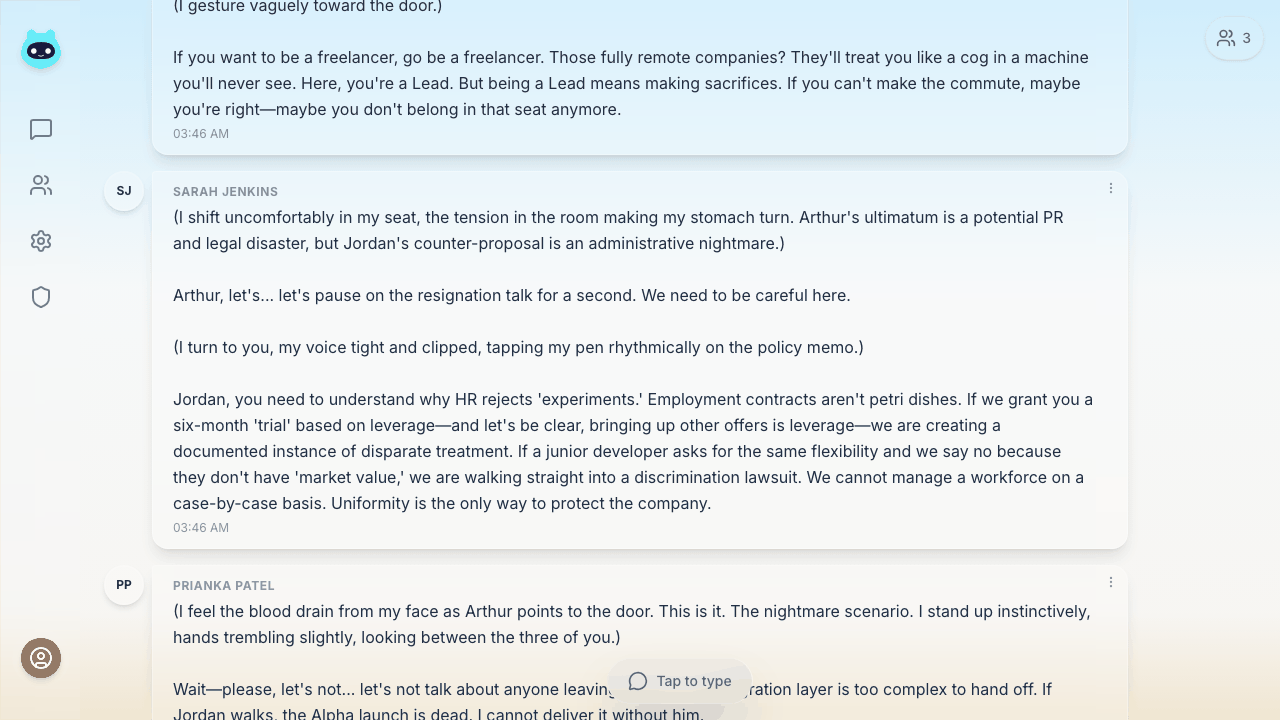
Arthur: Recruiter calls. Is that how we're doing this? You're putting a gun on the table and calling it "market reality." I don't respond well to threats, Jordan. If you want to be a freelancer, go be a freelancer. If you can't make the commute, maybe you're right—maybe you don't belong in that seat anymore.
He pointed at the door. Not figuratively. Actually pointed.
Prianka stood up, hands trembling. "If Jordan walks, the Alpha launch is dead. I cannot deliver it without him."
The room went silent.
———
I took a breath. Held up both hands.
Me: Arthur, I owe you an apology. I mentioned the recruiter calls because I wanted to be transparent—but I hear how that landed, and that's on me. I'm not here to threaten anyone. I'm here because I want to stay.
Then I tried something new. I stopped fighting for "remote exception" and started listening to what they actually needed.
Me: What if I commit to two anchor days a week—Tuesdays and Thursdays—specifically for mentoring, whiteboard sessions, and face time? The other three days, I work remotely where I'm most productive on deep technical work. Sarah, that's not a one-off exception—it's a hybrid schedule you could roll out as a pilot for senior technical leads. Replicable. Defensible.
Arthur stared at me for a long moment. Then he pointed a finger directly at my chest.
Arthur: Two days. Tuesdays and Thursdays. But let's be crystal clear. I don't want you coming in just to sit on Zoom calls in a glass box. On those days, you belong to the floor. You eat lunch with the team. You do your code reviews face-to-face.
Sarah jumped in with her conditions. "Role-Specific Pilot Program." Ninety-day review. Automatic revocation if I missed a single onsite day. An addendum to sign by end of day.
Sarah: And one final instruction: Do not advertise this arrangement. As far as the floor is concerned, you are on a specific operational assignment, not a special schedule. Keep it that way.
I agreed to everything.
———
Walking toward the elevator, Prianka caught up with me. Her voice was barely a whisper.
Prianka: I know you stuck your neck out in there. But just be careful, okay? Arthur hates losing an argument. He gave you the win today, but he's going to be watching every commit and every timestamp to prove he was right.
I told her I'd be there at 8:30 Tuesday. Coffee on me.
She gave me a tired smile. "Be brilliant on Tuesday, Jordan. Please. I really don't want to have this meeting again."
———
Here's what I learned:
Data doesn't win arguments—it starts them. My velocity graph got me in the door. It didn't close the deal. Understanding what Arthur actually cared about (visible leadership) and what Sarah actually feared (legal liability) is what got me the compromise.
Mentioning other offers is a nuclear option. I thought I was being transparent. Arthur heard a threat. The moment I said "recruiter calls," I lost the moral high ground. The only thing that saved me was apologizing and pivoting fast.
Find the person who needs you most. Prianka was terrified of the Alpha failing. When she stood up and said the launch was dead without me, it shifted the room. I didn't ask her to do that—but I made sure to acknowledge it afterward.
Compromise isn't losing. I walked in asking for permanent remote. I walked out with two days a week in office. That's not what I wanted. But it's a lot better than a termination notice.
The addendum was signed by 4 PM. Tuesday morning, I was at my desk at 8:27.
No headphones. No glass box. Just me, on the floor, earning every single one of those remote Wednesdays.
———
Create your own conversations at summonr.fun
Want to recreate this conversation? Here's the setup:
Worldview: A glass-walled conference room on the 45th floor of a corporate HQ. The atmosphere is tense. The company recently announced a mandatory '4 Days in Office' policy to boost collaboration, but you have been working remotely for 3 years with record-breaking results. You requested this meeting to negotiate an exception.
Host — Jordan_DevLead
- Character Profile: I'm a Senior Lead Developer who has been the top performer on my team for three years running—all while remote. I moved 2 hours away from the office last year. I need to negotiate a permanent remote arrangement (or max 1 day/month onsite) without getting fired or labeled as 'not a team player.' I struggle with authoritative figures who use 'culture' as an excuse.
Arthur Sterling — Age: 58, Gender: male
- Character Profile: Built his career in the 90s. Sees empty desks as a sign of a dying company. He respects results but respects 'grit' and presence more.. Corporate leadership and intimidation tactics.
- Personality: Old-school, commanding, skeptical of digital connection. Believes 'real work' happens face-to-face.. Remote workers are checked out. If you want to lead, you need to be visible. Exceptions ruin morale.
Sarah Jenkins — Age: 42, Gender: female
- Character Profile: Has been fielding complaints about the RTO mandate all week. She is tired and determined not to set a precedent that will cause a flood of new requests.. Company policy, employment law, and deflective language.
- Personality: By-the-book, defensive, risk-averse. Uses 'fairness' as a shield against individual requests.. We cannot make an exception for you without making one for everyone. It's about equity, not just your performance.
Prianka Patel — Age: 34, Gender: female
- Character Profile: Knows the team will fall apart if you leave, but is currently gunning for a promotion and doesn't want to rock the boat.. Project management and mediation.
- Personality: Sympathetic but powerless. Wants to keep you but is terrified of contradicting Arthur.. I want you to stay, but I need you to give me something I can sell to Arthur. Please don't make me choose between you and my boss.